

Turnaround – What Is It?

The definition of a Turnaround is a structured effort to restore a struggling company to financial health.

While the definition sounds straightforward, the real work goes beyond the restoration of balance sheets, profit-and-loss or positive cash flows. Every business has its own unique idiosyncrasies,  internal politics and stakeholder pressures — and these can often define how a turnaround unfolds and whether it will be successful.

That’s where experienced advisors play a crucial role: combining financial insight with an understanding of people, process and practical realities.

Objective

The goal of any turnaround is simple — to keep moving forward.

As Rocky Balboa famously said:

“Life is not about how hard you can hit. It’s about how hard you can get hit and keep moving forward.”

That same principle applies in business recovery. The path to stability is rarely smooth, but progress comes from persistence, adaptability and a clear focus on outcomes despite what obstacles are placed in front of you.

Execution

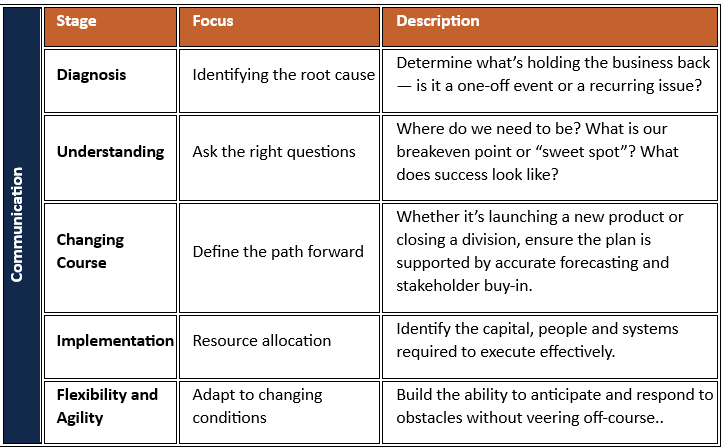
A successful turnaround typically moves through a series of key stages.
At every point, communication remains the foundation of success.
Competing Resources

Every turnaround face will face resource constraints and like the Project Management Triangle these are usually time, scope and cost.

Success depends on managing these competing factors and understanding that improving one often requires trade-offs with another.

Stakeholders play an important role in agreeing priorities and their needs will likely  differ.
Balancing these needs requires experience, diplomacy, and clear communication — qualities that seasoned turnaround professionals bring to the table.

While technology can enhance analysis and forecasting, the judgment and empathy needed to lead a successful turnaround remains firmly a human skill.


At Cathro & Partners, our team brings decades of hands-on turnaround experience across multiple industries.

We understand that early engagement is critical — the sooner action is taken, the more options remain available for the business, its clients, and stakeholders

For a confidential discussion on any of the above, please reach out to one of our experts

SERVICES

Services

Recent Articles

A construction business can be profitable on paper and still run out of cash. In this episode of The Cut, host Chris Bergin speaks with Victor Zhou, a fractional CFO specialising in the construction sector, about why cash flow problems develop, how builders and developers can identify them early, and

A construction business can be profitable on paper and still run out of cash. In this episode of The Cut, host Chris Bergin speaks with Victor Zhou, a fractional CFO specialising in the construction sector, about why cash flow problems develop, how builders and developers can identify them early, and

You receive an urgent email from the CEO requesting a payment be processed before the end of the day. The email looks genuine, the writing style appears familiar, the address is correct and relevant supporting documentation is attached. You know the CEO has been flat out on a new project

You receive an urgent email from the CEO requesting a payment be processed before the end of the day. The email looks genuine, the writing style appears familiar, the address is correct and relevant supporting documentation is attached. You know the CEO has been flat out on a new project

How a creditor-supported restructuring preserved regional childcare centres, protected jobs and delivered a materially better outcome than liquidation. The restructuring of the Believe Early Learning businesses is a practical example of what voluntary administration can achieve when a childcare operator has viable services but an unsustainable financial structure. The process

How a creditor-supported restructuring preserved regional childcare centres, protected jobs and delivered a materially better outcome than liquidation. The restructuring of the Believe Early Learning businesses is a practical example of what voluntary administration can achieve when a childcare operator has viable services but an unsustainable financial structure. The process