


When an insolvency practitioner is appointed to a small or medium enterprise (“SME”), a consistent pattern emerges in relation to the owner’s investment in the company. In the majority of cases, the business owner has put a substantial amount of their own money into the business, typically drawn from savings, a personal loan or a redraw against the family home and that money has either been recorded as share capital or as a loan that was never documented or secured.
The small minority of business owners who structured their contribution properly are in a different position.
If the company fails, they have a real prospect of recovering some or all of their investment. They are also better placed to restructure and continue funding the business when further contributions are required, knowing their position is protected.
This article examines why the way a business owner’s contribution is recorded at the outset usually determines the outcome and the steps business owners and their advisers can take to protect that contribution.
Why Business Owners Need to Protect Themselves
The statistics show why this matters.
At 30 June 2025 there were approximately 2.7 million actively trading businesses in Australia, around 97% of which are small businesses with fewer than 20 employees. In 2024-25 alone, 437,150 businesses commenced trading and 370,500 exited, an annual churn of roughly 30% of all businesses. ABS survival data indicates that fewer than half of new businesses are still trading three years after starting.
Banks do not lend to small businesses without taking security because they factor in the possibility of failure from the outset. Business owners carry the same risk, frequently with a greater proportion of their personal wealth at stake, yet very few take the same precaution.
What the Company Books Usually Show
In the typical SME insolvency, the company’s records will show the business owner’s contribution in one of two forms:
- as paid-up capital
- as a loan account that was noted by the accountant in the journal but never supported by a written loan agreement, never secured against the company’s assets and never registered.
Who Gets Paid First When a Company Fails
When a company is wound up, the insolvency practitioner does not divide the money evenly. The priority of payment is determined by section 556(1) of the Corporations Act 2001 (Cth). Where the business owner sits in that priority is determined entirely by decisions made, or not made, long before an insolvency practitioner is appointed.
The table below reflects a pattern typical of an SME insolvency, showing the same business owner contribution of $90,000 under the three structures most encountered:
- Recorded as equity
- Recorded as a loan that was never documented and/or secured
- Documented as a secured loan registered on the Personal Property Securities Register (“PPSR”) from the outset.
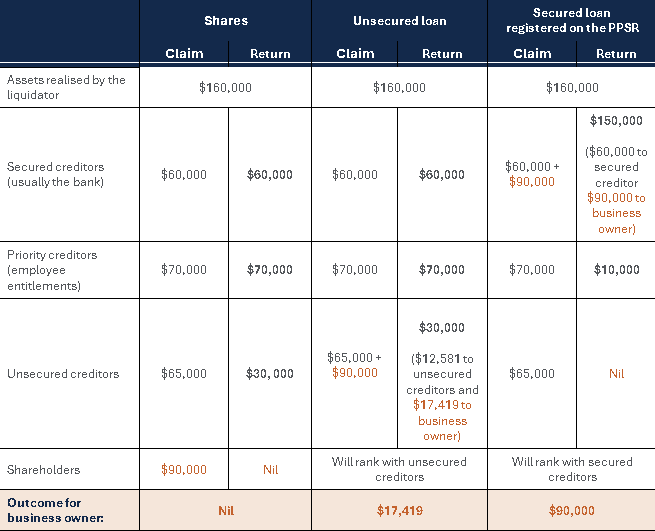
For simplicity, the illustration assumes the funds realised are from non-circulating assets. In a typical SME, a significant part of a business owner’s contribution is applied to plant, equipment and fit-out, which are non-circulating assets with the balance funding working capital. Where asset realisations include circulating assets such as debtors, stock and cash, employee entitlements would rank ahead of the secured creditors to that extent.
The Secured Business Owner’s Position
In the above scenario, only the business owner in the third column recovers their investment. Notably, there is little practical difference between the first two columns: a business owner whose loan was never secured or registered is in substantially the same position as a business owner who made no loan at all.
The owner who documented the contribution as a loan, secured it by a general security agreement over the company’s assets and registered the security interest on the PPSR ranks as a secured creditor alongside the bank, with a real prospect of recovering some or all of their investment.
Knowing their position is protected, business owners can continue to invest in the company as the need arises, with a realistic expectation of recovering some or all of that money if the business fails, knowing any recovered funds can be applied to personal financial commitments or to fund a subsequent venture.
A registered secured position matters beyond liquidation. Where a company in difficulty is placed into voluntary administration, the owner is frequently the only party with both the incentive and the means to propose a restructure through a deed of company arrangement (“DOCA”) that allows the company to survive and rebuild.
The greatest obstacles to a viable DOCA is usually funding and the lack of support of the creditors. Sufficient funds must be available both to put an acceptable offer to creditors and to sustain trading through the administration period until the deed takes effect.
A business owner holding a registered security is in a materially stronger position and has genuine influence over that process. If the proposal is rejected, they retain their security over the company’s assets rather than losing their position along with the unsecured creditors. They can also defer repayment of their own debt to free up funds for unsecured creditors, who would otherwise likely receive little or nothing in a liquidation.
As a result, the business owner tends to seek advice earlier and can plan quickly to restructure the company. This in turn reduces the cost of the administration and the DOCA, preserves continuity of trading and improves the prospect of the company prospering again.
A secured position also gives the business owner greater bargaining power in negotiations with the company’s financier and in dealing with related exposures which can otherwise complicate a restructure.
Best Practice for Owners and Their Advisers
Most owners receive some version of this advice from their accountant when the business is established. In practice, however, the documentation rarely extends beyond a journal entry: the loan is never formally documented, never secured and never registered on the PPSR and the protection is lost.
The following steps are what place a business owner in the position of recovering some if not all of their investment as detailed in the table above:
- Document the loan: record every business owner contribution under a written, secured loan agreement at the time the funds are advanced, rather than leaving it as equity or a journal entry;
- Take security: support the loan with a general security agreement over the company’s assets;
- Register immediately: perfect the security interest by registration on the PPSR within the required timeframe – registration is inexpensive relative to the amounts at stake; and
- Review regularly: revisit the documentation and registration whenever further funds are contributed.
It’s important to note that documentation and registration must be done correctly and within the required timeframes in accordance with the Personal Property Securities Act 2009 (Cth). Defective registrations are routinely challenged and specialist advice at the outset is inexpensive relative to what is at stake.
The costliest mistake an SME business owner makes is often made at the outset, in how their own contribution to the company is recorded. Whilst it is best to secure owners’ loans when they are made, the most important thing is that loans are secured at any stage, even years after they are made. But, they need to be secured as far away from when that security needs to be relied upon. That is usually at least six months before a company becomes insolvent.
Owners who contribute personal funds without securing them rank, in the overwhelming majority of liquidations, as unsecured creditors with little prospect of recovery.
By contrast, owners who structure their position as a bank would, by documenting, securing and registering the loan correctly, preserve a real prospect of recovering some or all of their investment if the business fails, as well as genuine leverage to rescue the company if it can be saved. It also gives them the reassurance that they have done everything they can to protect their position.
Krodok
Krodok is an online tool that enables SME owners (or their advisers) to document and register their security on the PPSR quickly, simply and cost effectively. This is appropriate for owners and related parties that lend money to a company. Owners can go to Krodok’s website to fill out the form. It takes five minutes and costs less than $1,000.
Crucially, the Krodok system not only protects new loans, it also protects loans that were made years earlier, so long as that security is put in place as far away as possible from when an owner needs to rely upon it. That period is at least six months before insolvency; but, the best time to put the protection in place is now.
Simon Cathro recently spoke to Matthew Kelly, the founder and managing director of Krodok, on The Cut podcast. Matthew spent nearly 20 years as a practising lawyer in the insolvency and restructuring space, before setting up Krodok with the desire of helping SME owners protect their business and survive the insolvency process.